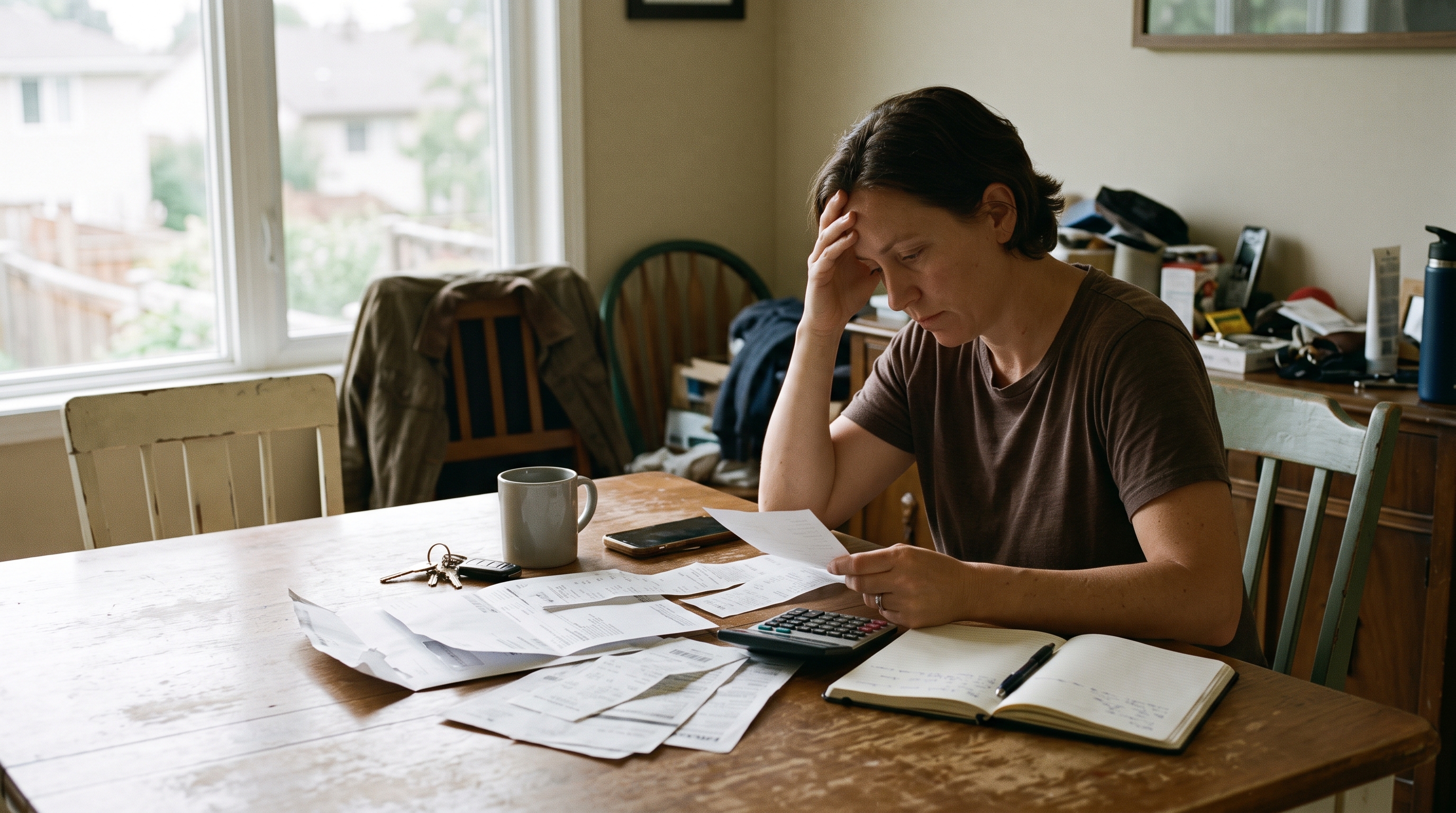
If you have looked at your bank account, opened an electric bill, or walked out of the grocery store lately feeling a sinking dread in your stomach, you already know the heavy background hum of modern life.
There is an old, honest truth about human life: between the things that happen to us and the way we respond, there is a small space. In that space lies our power to choose—and in that choice lies our freedom. But when life gets this expensive and uncertain, that space shrinks fast, and most of us get pulled right into one of two traps:
The first trap is the downward spiral. We look at the numbers, we look at the news, and we panic. We get angry, we feel defeated, and we play out worst-case scenarios in our heads until our chest is tight and we can barely sleep.
The second trap is the "positive vibes" trap. We try to talk ourselves out of the pain. We tell ourselves to just stay positive, that everything happens for a reason, or that it is all in our mindset. But our bodies know better. Pretending things are fine when the rent just went up doesn’t bring peace—it just makes us feel like we’re crazy, or like we're failing.
Here is the honest question so many of us are wrestling with right now: How do we find calm and protect our sanity without lying to ourselves about how hard things actually are?
The answer isn't positive thinking, and it doesn't require adopting any ancient religion. It is about understanding how human biology works, how our minds create stories, and how to practice something simple I call Double Holding.
There is a timeless teaching that says pain in life comes in two distinct waves: The Hit and The Story.
The First Hit is the real-world event. Getting a flat tire, getting sick, watching the price of eggs double, or getting an unexpected medical bill. These are real, physical impacts. They hurt.
The Second Hit is what our mind does with that event: the self-blame, the shame, and the catastrophic predictions—telling ourselves we're idiots, we're never going to get ahead, or that everything is ruined.
Let’s be completely clear: the rising cost of living is a real hit.
We face it every single day:
Groceries and power bills climbing every few months
Housing and rent eating up bigger slices of our paychecks
Being nickel-and-dimed by subscriptions just to watch a ballgame
The constant, quiet worry: "Will my paycheck cover next month?"
When your grocery bill is $80 higher than it used to be for the exact same cart of food, that is not in your head. It is a real, practical challenge. It is not a failure of your character, nor is it proof that you lack the ability or worth to build a decent life. It is the difficult economic reality of our time.
Pretending it doesn't matter is just gaslighting yourself. The very first step toward inner peace is simply telling the truth: This is hard. This is the difficult reality. And our bodies are completely normal for feeling the weight of it.
Before you even have a chance to say a word about money, your body has already reacted.
Think about the last time you saw an unexpected expense. Where did you feel it first?
For almost all of us, it hits in the exact same spot: a tight, cold, hollow knot right below the ribcage, right in the pit of the stomach.
It happens in a split second:
You see the bill or the price tag.
Your primitive alarm bells go off.
The belly tightens, and your breath gets shallow.
Your body braces for famine and danger.
Why does it land there?
Your conscious mind understands modern things like checking accounts, credit scores, and utility rates. But the deeper, older parts of your brain and body don't know what a bank is. They evolved over millions of years with only two basic settings: Safe and Fed, or Threatened and Starving.
When your eyes register a threat to your resources, your body treats an unpaid bill the exact same way our ancient ancestors treated a harsh winter with no food. Your breathing gets shallow as the diaphragm freezes to keep you quiet while watching for danger. Digestion shuts down to divert energy to your muscles. Your stomach muscles tighten to physically protect your vital organs from impact.
That knot in your gut isn't an intellectual problem. It is your inner animal bracing for famine.
When that knot hits, most of us do what comes naturally: we panic.
We either get swallowed up by the knot, thinking we can't handle it, or we get mad at ourselves for being anxious and tell ourselves to get it together. That reaction leads straight into sleepless nights, short tempers, and snapping at the people we love.
Here is the turning point: You are not the knot.
Pause for a second and notice. You can feel the tightness in your stomach. You can feel your heart beating faster. You can hear the worried thoughts racing through your head.
If you can observe the tight knot, that means you are the one watching it—not the knot itself.
Your worried thoughts, your knotted stomach, and your fast heartbeat are all moving storms. But they are being observed by the steady you: the spacious witness, or simply the part of you that's noticing. The storm passes through; the sky itself is never destroyed.
The calm observer inside you isn't starving. It isn't broke. It is simply the quiet, steady awareness in which these physical feelings are happening.
When you are trapped inside the panicked knot, you can't think clearly. You make desperate moves, you buy things impulsively to comfort yourself, or you shut down and stick the bills in a drawer.
When you take a breath and step back into the seat of the calm observer, you get your brain back. You step out of survival panic so you can look at your life with clear eyes, make smart choices, and protect your peace.
When economic stress hits, our suffering explodes because we confuse the math with the myth.
The Math: "I have $300 less left over this month than last year."
The Myth: "I am a total failure. I can't take care of my family. I am worthless."
The Math: "Electric rates went up 25% across our whole town."
The Myth: "The world is out to get me. Nothing ever works out for me."
The Math: "Groceries cost a lot more than they used to."
The Myth: "I am completely trapped and powerless."
The Math is a practical puzzle. It requires budgeting, cutting expenses where possible, looking for extra income, or asking for help.
The Myth is an attack on your character and your dignity.
Solving the math takes time and effort. But you can stop the myth right now by drawing a firm line: This is a math problem to solve. It is not a verdict on who I am as a human being.
How do we put all of this together when stress knocks on our door?
I call it The Practice of Double Holding: fierce honesty about the world outside, and unconditional kindness for the body inside.
Here are four simple steps to practice in real time:
1. Admit the Truth
Don't pretend it doesn't hurt. Say it plain: "This is genuinely tough. Things are tight right now, and it makes complete sense that my stomach is in knots." This stops the exhausting game of pretending you shouldn't be worried.
2. Drop the Story
Catch the voice that starts beating you up: "Wait a minute. That’s just fear talking. Having a tight budget doesn't mean I’m a failure. My self-worth doesn't depend on the economy."
3. Comfort the Animal Inside
You cannot talk your stomach out of a knot using a spreadsheet. You have to speak the body's language: warmth and breath.
Put your hand on your upper belly, placing your palm flat right where that knot lives beneath your ribcage, and let the warmth sink in. Take a resetting breath by taking two quick inhales through your nose, then letting out one long, slow sigh through your mouth. Doing this two or three times immediately slows your racing heart and tells your body you aren't in physical danger.
Then talk to your body like a good friend: "I know you're scared of running out of things. But look around—right now, in this room, we have air to breathe. We have a roof over our heads. We are safe in this moment. Let me work on the practical stuff outside; you can rest inside."
4. Take Grounded Action
Calming your body isn't about ignoring problems; it’s about giving yourself a steady cushion so chronic stress doesn't wear you down.
When your body stays flooded with worry day after day, it wrecks your sleep, spikes your blood pressure, tears down your immune system, and leaves you mentally exhausted. Learning to work with stress protects your health. When your stomach unclenches and your head clears, you can take smart, grounded action:
Cancel subscriptions you don't use, audit your bank statements, and eliminate sneaky fees with calm determination.
Decide what truly matters this month without beating yourself up over what has to wait.
Reach out to trusted friends, family, or local community resources if necessary. Reaching out isn't a sign of weakness—it is an act of courage and honest human connection.
Remember you are not alone; millions of good, hard-working people are feeling this exact same squeeze right now.
Despite everything going on in the world, and despite whatever tight financial squeeze you might be facing today, the most important thing is that you do not forget your self-worth and your dignity.
We must have deep compassion for the real difficulties we are up against, instead of falling into bitter resentment, blaming others, or acting out in anger. Lashing out at the people around us is just fear trying to find an exit; it never fixes the problem, and it only hurts the people we love.
This is why we practice Double Holding:
With one hand, we hold the difficult, honest truth of the bills, the grocery receipts, and the economy—refusing to hide from reality, and meeting our lives with courage and clear thinking.
With the other hand, we hold our own hearts and bodies with kindness, patience, and self-respect—refusing to let our worth be defined by a bank balance.
The world outside may be shaking, but when you practice Double Holding, the ground beneath your feet can remain completely solid.