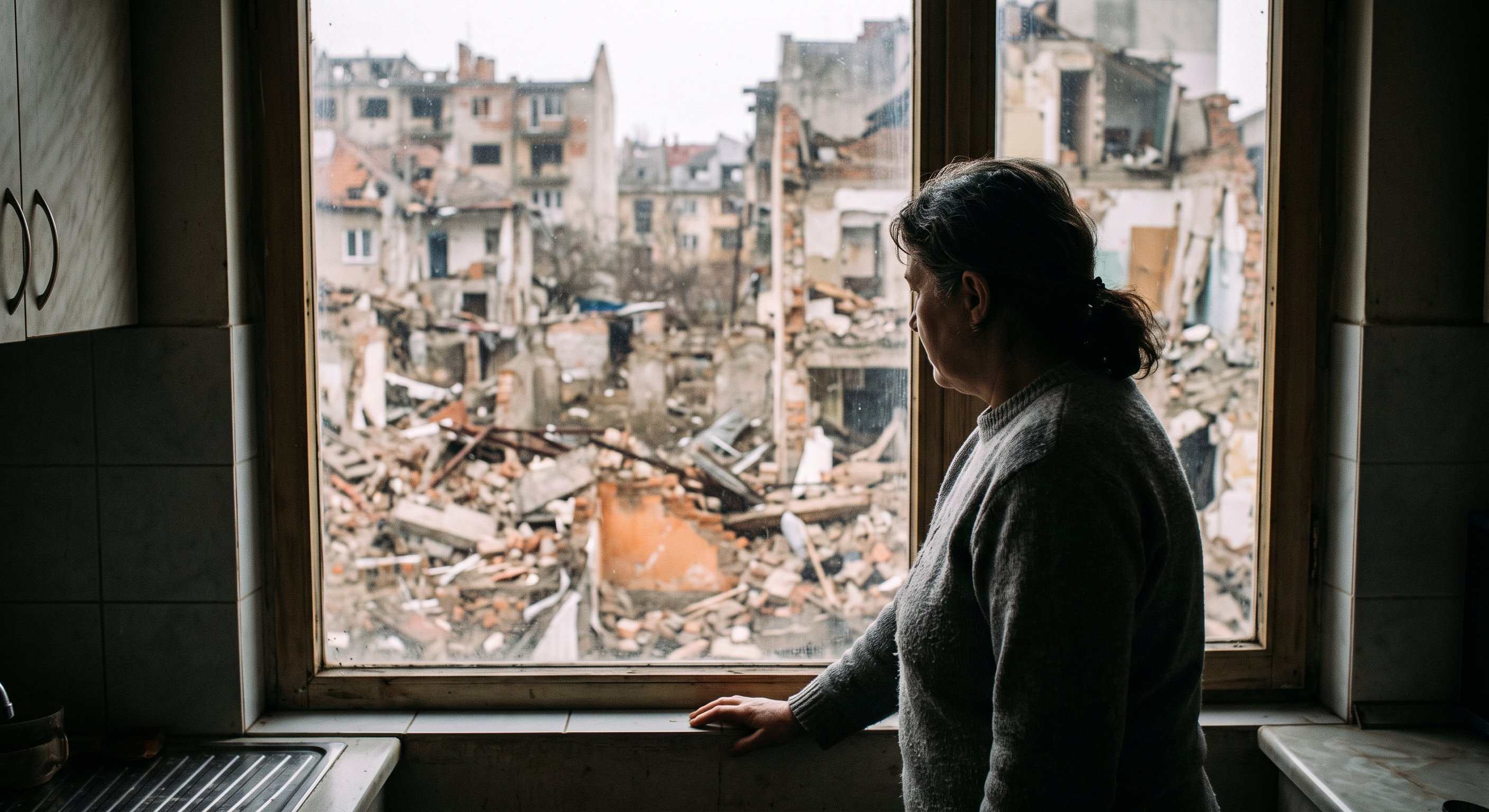
We live in a culture profoundly addicted to being right.
From cable news panels and social media threads to dinner table debates and legislative chambers, our public life often resembles an unrelenting courtroom trial. But beneath the noisy rhetoric, this theater is driven by quiet, selfish motives—corporate greed, political ambition, and our own desperate, unexamined urge to protect our fragile egos.
We don't just look for truth; we audition it. We scour the internet, cherry-pick isolated data points, and stretch the facts just enough to make ourselves look blameless and our opponents look monstrous. We convene an immediate judge and jury inside our heads. The goal is rarely mutual understanding, reconciliation, or healing—it’s feeding the machine of outrage, crushing the opponent, feeling morally superior, and getting our own way.
Yet, in our desperate rush to be right, a quiet, devastating tragedy occurs: we lose track of what is true, we abandon what is beneficial, and we completely forget the big picture.
Decades ago, in the forest monasteries of northeast Thailand, a young American monk named Sumedho found himself burning with righteous indignation. Another monk in the community had a loud, abrasive mouth, constantly upsetting people and stepping on everyone's toes. When their teacher, Ajahn Chah, went away for a few days, Sumedho seized his moment. At a formal gathering, he stood up with dates, witnesses, and facts in hand. He laid out an airtight case against the offending monk. His evidence was undeniable; he was completely, factually correct.
The public confrontation was so humiliating that the criticized monk packed his bowl and robes that very night, left the monastery, and never returned.
When the teacher came back and learned what had happened, he called young Sumedho into his hut. Instead of praising his sharp eye for rules and accuracy, the elder delivered a gentle, piercing rebuke:
“You know, you did something very harmful there. His mouth is bad, but his heart is good. How many monasteries do you think the fellow had to leave before he came here? This was the one place where he could stay and practice, because I made space for him. Now you have closed that door on him... You were right in fact, but wrong in Dhamma.”
In traditional monastic circles, they call that being wrong in Dhamma. But down on the sidewalk, in ordinary life, it simply means this: You can be completely right on the facts, and yet totally wrong in spirit.
Truth is a non-negotiable foundation for living an honest life. But there is a vital distinction that modern society almost entirely ignores: truth alone is not a license to speak or act.
When our minds are clouded by our own selfish motives, we treat honesty like a weapon. We selectively pull out a painful fact, wait for the exact moment the other person is vulnerable, and drive it home—all so we can savor that cheap, intoxicating rush of feeling morally superior and getting our own way. Then we hide behind the cowardly defense: “Hey, I’m just being honest. It’s the truth!”
Truth divorced from care is not honesty; it is hostility in disguise.
An ancient, timeless guide for communication reminds us that even if a statement is factually accurate, if it doesn't help—if it wounds, inflames, or tears down the community without healing—a wise person leaves it unsaid.
Before we open our mouths or hit send on a reply, our words need to pass through four simple gates:
Is it true? (The factual foundation, free of our convenient stretches, omissions, and personal biases)
Is it beneficial? (Does it actually help relieve a burden, or does it merely feed our selfish craving to dominate?)
Is the timing right? (Can the listener's heart actually receive it right now?)
Is it offered with kindness, with zero intent to harm? (Is it coming from genuine care, or are we throwing a punch disguised as advice?)
It’s tempting to think this problem only belongs to loud politicians, cable news pundits, or social media combatants. But the truth is, this courtroom is in session inside each of us, all day long, right down on the pavement.
I catch myself doing this constantly when I'm driving. I'll be sitting at a light or moving along a two-lane road, and I'll see someone drifting out of their lane, driving five miles an hour under the speed limit. I pull up beside them, glance down, and sure enough—they're staring down at their smartphone.
Instantly, my inner judge and jury bangs the gavel. The self-righteous monologue starts rolling: “Look at them! How reckless! Put the damn phone down and pay attention to the road!”
Technically, factually, I am dead right. They shouldn't be texting while driving. It is unsafe. But look at what is really driving my fury: my own selfish convenience. They slowed me down. They disrupted my lane. They got in my way. And in my sudden rush to feel morally superior and get my own way, I completely lose the big picture.
I don't know what is happening inside that car. Maybe they are an exhausted parent receiving an emergency text from their kid. Maybe they just got news of a sudden medical crisis. Maybe they are simply a fallible, stressed-out human being making a clumsy mistake, just like I have made a thousand times behind the wheel. But my inner prosecutor doesn't care about their story; it only cares about convicting them so I can sit comfortably on my high horse. Meanwhile, my jaw is clenched, my neck is hot, and I’ve poisoned my own afternoon just to feel superior for thirty seconds.
You see it at the kitchen counter, too. Your spouse or partner loads the dishwasher "wrong," forgets an errand, or misremembers a date. You have the facts on your side. You can pull up the calendar, selectively present the evidence where they slipped up, conveniently bury the memories of the times you dropped the ball, and win the trial hands down.
When the dust settles, what have you actually won? You won the debate, but you bruised the trust. You proved your point, but you created a chilly, quiet distance across the living room. You traded the big picture—the warmth and sanctity of a shared life—just to feel morally superior and get your own way.
We see this exact same tragedy play out on a massive scale when our own government completely loses sight of the big picture.
Instead of organizing public life around genuine care, mutual protection, and the basic well-being of everyday human beings, our institutions have largely surrendered to corporate balance sheets, wealthy donors, and the endless pursuit of profit. Leaders stand at podiums quoting statistics, legal statutes, and budget projections to prove their policies are technically justified. But beneath the bureaucratic language lies that same cold, selfish instinct: serving money and power so the machine can get its own way, while ordinary families are left to struggle with soaring medical costs, crumbling neighborhoods, and neglected lives. When a government cares more about padding corporate profits than sheltering and healing its own people, it is running the exact same play we run at the kitchen sink: trading living human connection for a sterile, heartless victory.
This is where the rubber meets the road. Living with real awareness isn't about floating above life; it’s about catching the exact moment our inner gavel hits the sounding block:
Why do I feel this sudden, frantic urge to correct a complete stranger?
What selfish itch am I trying to scratch by humiliating this person?
Do I want to be "right," or do I want to be in healing relationship?
When we lack that basic self-honesty, our opinions turn into body armor. We walk around carrying mental clipboards, grading everyone who crosses our path: the slow cashier, the teenager with facial piercings, the neighbor whose lawn is overgrown, the car that hesitates for two seconds at a green light. We convince ourselves that we are just sharp observers of reality. In truth, we’re just projecting our own inner tightness onto the world to feel like we're in control.
When millions of individual, unexamined inner courtrooms gather in a society, that personal habit of self-righteousness scales up into collective cruelty.
Look at the relentless rhetoric surrounding immigration. Political figures stretch, distort, and cherry-pick reality to serve an ulterior motive—manufacturing panic to consolidate power and get their own way. We are spoon-fed an engineered narrative designed to provoke raw, primal fear: that the human beings crossing our borders are "criminals," "invaders," and threats to our way of life. The societal courtroom bangs its gavel, sentencing millions of people before their stories are ever heard.
They pick out isolated incidents and present them as the entire truth. But if we step out of our political bubbles and look with honest eyes, what is the big picture?
The reality is that our daily comfort is quietly carried by the labor of immigrant hands. They are the mothers and fathers out in the fields before sunrise picking the fruit and vegetables on our tables. They are washing our dishes, cleaning hospital rooms, caring for our elderly, and framing our homes. They are human beings carrying an extraordinary weight of sacrifice simply to give their kids a shot at life away from violence or starvation.
Yet, under the banner of legalistic correctness, we see families torn apart and vulnerable people treated like cargo. Those who defend these policies can point to a legal statute and claim they are technically within the law. But looking through the lens of basic human empathy, tearing a child from a mother's arms is a moral failure. It is right in code, but bankrupt in spirit.
Centuries ago, an ancient story tells of a brutal drought that struck northern India. The Rohini river dried down to a muddy trickle between two neighboring farming clans. Both sides claimed the rightful share of the remaining water to save their crops. The dispute escalated from heated arguments to bitter insults, until armies mobilized on opposite banks, armed with spears and bows, ready to slaughter one another over a muddy riverbed.
A wise teacher walked out into the middle of the dry riverbed, stood directly between the drawn battle lines, and asked the leaders:
“Tell me: What is the market value of this muddy water?”
“Very little,” they answered.
“And what is the value of human blood, of a human life?”
“It is beyond measure. It is priceless.”
“Would you really destroy what is priceless for something that costs so little?”
Ashamed by the plain honesty of the question, the warriors laid down their weapons.
You can take that river and substitute almost any war or crisis in human history—where human beings fight bitterly over something they value, completely blind to the catastrophic cost of the fight itself. We see it in boardroom balance sheets today. Conglomerates pump clean aquifers dry and sacrifice the health and livable wages of entire communities on the altar of quarterly returns.
Economic analysts can produce mountains of spreadsheets proving their decisions are financially justified. But their vision is deliberately selective. They omit the cost to the living world so corporate power can get its own way. They have forgotten the fundamental question: Would you sacrifice what is priceless—the health, dignity, and survival of living beings—for what has only temporary, transactional value?
An economic model that requires the grinding down of humanity to feed profit has lost its soul. A healthy society is built on collective stewardship for mutual flourishing, not on trading human well-being for financial gain.
Nowhere is the poison of "being right" more horrifying than in the theater of modern warfare.
When we look at the immense devastation in Gaza, Palestine, and across the Middle East, the prevailing political voices immediately demand that we pick a camp. We are instructed to keep an ideological scoreboard: to grieve passionately for the innocent lives taken on one side, while coldly dismissing the slaughter of children, parents, and healthcare workers on the other side as unavoidable "collateral damage."
Both sides can point to real atrocities, real grief, and real historical grievances. They have facts to support their rage. But when facts are selectively weaponized to justify revenge, vengeance masquerades as justice. As the old truth reminds us, an eye for an eye leaves the whole world blind. Hatred has never once been cured by more hatred; it is only healed when someone has the courage to break the cycle with care.
Unconditional care does not carry a passport. It doesn't check a flag, an ethnic lineage, or a religious creed before deciding whether a tear is worth shedding. A mother weeping over the crushed body of her child in Gaza is feeling the exact same gut-wrenching, world-ending agony as a mother weeping over her child in Tel Aviv, Kyiv, or anywhere else on this planet. Every single life extinguished is an entire universe wiped out.
If our political stance requires us to numb our hearts to the slaughter of another human being just so our "side" can maintain its self-righteousness, our stance is poisonous. We have traded the sacred whole for the petty satisfaction of feeling morally superior.
Why has it become so effortless for cultures to slide into cruelty?
It starts with our casual acceptance of dishonesty. In modern public discourse, lying has ceased to be a scandal; it has become an accepted PR strategy. Leaders and influencers fabricate blatant falsehoods about vulnerable groups, elections, and global events with total impunity—all to win a vote, protect their power, or milk an algorithm for clicks.
There is an old story of a father talking with his young son, who had told a deliberate lie just to be playful. The father washed his feet in a wooden water dipper, left a tiny puddle of dirty water at the bottom, and held it up. “Do you see this little bit of dirty, leftover water? That is how little integrity is left in someone who feels no hesitation in telling a deliberate lie.”
Then the father tossed the water out, flipped the dipper upside down on the dirt, and said: “Even so hollow and turned upside down is the life of someone who feels no shame at a lie. When a person no longer cares about what is true, there is no harm they cannot do.”
To give the boy a compass for life, the father offered a simple practice: The Mirror of Action. “What do you use a mirror for?” he asked.
“To see my reflection,” the son replied.
“In that exact same way, before you speak or act, while you speak or act, and after you speak or act, hold up the mirror and ask: Does this cause harm to me, harm to others, or harm to both? If it causes harm, put it down.”
Notice the father didn't teach his son to ask: “Will this win the argument? Will this make me look smart? Will this get me my own way?”
He asked one question: Does it cause harm?
When we witness the sheer scale of unfairness around us, anger and fear are completely natural reactions. But how do we stay engaged without turning into the very bitterness we are trying to stand against?
There is an old account of a furious, self-important man who was deeply offended by a quiet teacher. The man walked up and unleashed a torrent of vicious, personal insults, screaming right into the teacher's face. The teacher listened quietly until the man ran out of breath, and then asked: “If you buy a gift for someone and they refuse to take it, who does the gift belong to?”
The angry man snapped: “It belongs to me, of course.”
The teacher looked at him steadily: “In the same way, the insults, poison, and hatred you bring here—I refuse to accept them. They remain entirely yours. If I throw hatred back at you, I’m sitting down at the table to share your meal. I choose not to eat with you.”
That is the lesson we desperately need right now. The outrage industry depends on us accepting its toxic delivery and firing it right back into the world. The moment we retaliate with matching cruelty, we have pulled up a chair and begun eating the poison.
Refusing the gift does not mean rolling over or playing dumb. It means standing up for immigrant neighbors, opposing corporate greed, and calling for an end to war with a mind rooted in clarity, steady courage, and unconditional care.
Real healing—whether in an international conflict or across a kitchen table—never happens on an island. It cannot occur as long as we insist on total, unconditional surrender from the other side.
Healing demands something our egos deeply resist: a willingness to make room for the whole.
It asks for a measure of self-sacrifice. Not the toxic kind where you allow yourself to be mistreated or stay silent in the face of abuse, but the humble, courageous sacrifice of your own pride. It means giving up the intoxicating thrill of delivering the crushing blow. It means giving up the petty demand of feeling morally superior and getting our own way. It means being willing to yield the right-of-way, to swallow the clever comeback, and to let the other person save face.
Sometimes, serving the big picture looks like saying: “You know what? Maybe I am missing something here. Help me understand what this looks like through your eyes.”
That isn't defeat. That is the highest form of bravery. It is the understanding that a relationship, a family, or a community is infinitely more valuable than our private scorecard.
So how do we take this off the screen and actually live it tomorrow morning?
It doesn't require going to a mountaintop or waiting for the world to suddenly wake up. It begins right in the middle of an ordinary day.
It begins the next time someone cuts you off on the freeway or drifts into your lane with their eyes glued to a smartphone. Instead of leaning on the horn or revving your engine with a face full of fury, you catch the contraction. You feel the knot in the stomach, the sudden heat in the neck, the voice gearing up to pass judgment. You breathe down into the soles of your feet. You let uncluttered awareness take over—seeing the event as it is without piling a federal case on top of it. You recognize that this person, clumsy and distracted as they are, is carrying their own messy, stressed-out life.
It happens at the kitchen counter tonight, when you're tempted to correct your partner about a forgotten detail or an errand done wrong. You catch yourself before laying out your courtroom evidence. You remember the big picture. You ask the humbling question: “If I win this point right now, what does it cost our connection? Is getting my own way worth bruising this heart?”
We can spend our entire lives clutching our rigid opinions, banging the gavel of our inner courtroom, and demanding that everyone acknowledge how right we are. But when we look back on our lives, nobody is going to care how many arguments we won or how fiercely we guarded our pride.
The only questions that will matter in the quiet of the heart are simple:
Did we help lift someone's burden, or did we just toss our own fear into a burning room?
Did we honor the priceless value of the living beings sharing this fragile Earth with us?
Did we have the courage to put down the heavy stone of being "right," so our hands were open to help?
It is time to put away the gavel. It is time to look into the mirror of action, refuse the poisoned gifts of our day, and choose to heal—starting right behind the steering wheel, across the kitchen table, and inside our own hearts.